目录
上文聊到了CFS的一个特性,调度周期,本文梳理一下cfs调度器的基本数据结构
task_struct
在linux系统中,所有的任务都是一个task_struct,所以我们从这里作为起点
struct task_struct {
        volatile long                   state;  # 状态
        int                             on_cpu;  # 是否当前CPU
        unsigned int                    cpu;  # CPU ID
        int                             on_rq;  # 是否在rq
        int                             prio;  # 优先级
        int                             static_prio;  # nice 优先级
        int                             normal_prio;  # 正常优先级
        unsigned int                    rt_priority;  # 实时优先级
        const struct sched_class        *sched_class;  # 调度类
        struct sched_entity             se;  # 调度实体
        struct sched_rt_entity          rt;  # rt的调度实体
        struct task_group               *sched_task_group;  # cgroup任务组
        struct sched_dl_entity          dl;  # dl的调度实体
        unsigned int                    policy;  # 策略
        int                             nr_cpus_allowed;  # 最大cpu值
        const cpumask_t                 *cpus_ptr;  # cpu_mask结构体
        cpumask_t                       cpus_mask;  # mask掩码
......
}
任务结构体管理调度实体,所以我们查看调度实体se
sched_entity
struct sched_entity {
        /* For load-balancing: */
        struct load_weight              load; # 权重
        struct rb_node                  run_node; # rb-tree
        struct list_head                group_node; # cgroup任务组
        unsigned int                    on_rq; # 是否在rq

        u64                             exec_start; # 执行时间
        u64                             sum_exec_runtime; # 累计时间
        u64                             vruntime; # 运行时间
        u64                             prev_sum_exec_runtime; # 上次累计时间

        u64                             nr_migrations; # 迁移次数

        struct sched_statistics         statistics; # 统计信息

        int                             depth; # 深度,cgroup使用
        struct sched_entity             *parent; # 父节点,cgroup使用
        /* rq on which this entity is (to be) queued: */
        struct cfs_rq                   *cfs_rq; # cfs rq
        /* rq "owned" by this entity/group: */
        struct cfs_rq                   *my_q; # cgroup下的cfs rq
        /* cached value of my_q->h_nr_running */
        unsigned long                   runnable_weight; # h_nr_running

        struct sched_avg                avg; # 负载均衡
};
调度实体管理运行队列,所以接下来看cfs_rq
cfs rq
struct cfs_rq {
        struct load_weight      load; # 权重
        unsigned int            nr_running; # 调度实体数量

        u64                     exec_clock; # 累计时钟
        u64                     min_vruntime; # 最小运行时间

        struct rb_root_cached   tasks_timeline; # rb-tree 根

        /*
         * 'curr' points to currently running entity on this cfs_rq.
         * It is set to NULL otherwise (i.e when none are currently running).
         */
        struct sched_entity     *curr; # 当前se指针
        struct sched_entity     *next; # 下个se指针
        struct sched_entity     *last; # 上个se指针
        struct sched_entity     *skip; # 需要跳过的se指针
......
}
runqueue管理的是rb-tree,所以接下来看rb-tree结构 tasks_timeline
tasks_timeline
struct rb_root_cached {
        struct rb_root rb_root; # rb-tree 根
        struct rb_node *rb_leftmost; # rb-tree 最左节点
};
到这里,cfs的基本结构大致为task_struct->sched_entity->runqueue->rb-tree
但是还有一个不应该忽视的,就是cgroup下的组调度
task_group
struct task_group {
        struct cgroup_subsys_state css; # cgourp状态

#ifdef CONFIG_FAIR_GROUP_SCHED
        /* schedulable entities of this group on each CPU */
        struct sched_entity     **se; # 调度实体
        /* runqueue "owned" by this group on each CPU */
        struct cfs_rq           **cfs_rq; # runqueue
        unsigned long           shares; # cgoup 份额
#ifdef CONFIG_RT_GROUP_SCHED
        struct sched_rt_entity  **rt_se; # rt的调度实体
        struct rt_rq            **rt_rq; # rt的runqueue

        struct rt_bandwidth     rt_bandwidth; # rt带宽控制
        struct cfs_bandwidth    cfs_bandwidth; # cfs带宽控制
#endif
......
}
task_group 中有两个重要的成员:其一是sched_entity 指针的数组,将其插入到其父 cfs_rq 的红黑树中,实现组级公平竞争,另一个则是 cfs_rq,用于管理该组内任务的调度队列。我们可以看到重点在task_group的分组行为。
默认情况下,可以按照上面描述的流程管理task_struct->sched_entity->runqueue->rb-tree,但实际上,可以通过cgroup分组,那么其流程管理为task_struct->task_group->sched_entity->runqueue->rb-tree
通过添加这么一个组的概念,借助my_q就可以使得cpu上的任务可以按组来管理了。
总结
本文将调度大的框架上的基本数据结构的交互进行了一个说明,可能很轻松的了解到调度在数据结构上是如何实现or流转的,同样的,我也整理了图示,如下
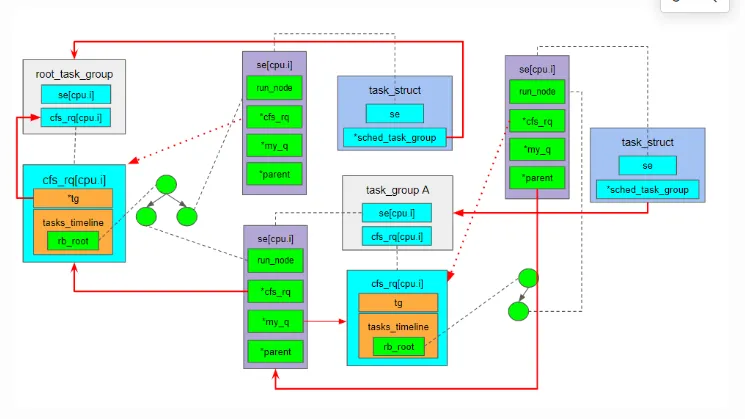
可以看到,所谓调度,就是从task_struct中,找到group/task内的se,通过se下的runqueue找到rb-tree,然后通过rb-tree进行任务管理,简单明了。
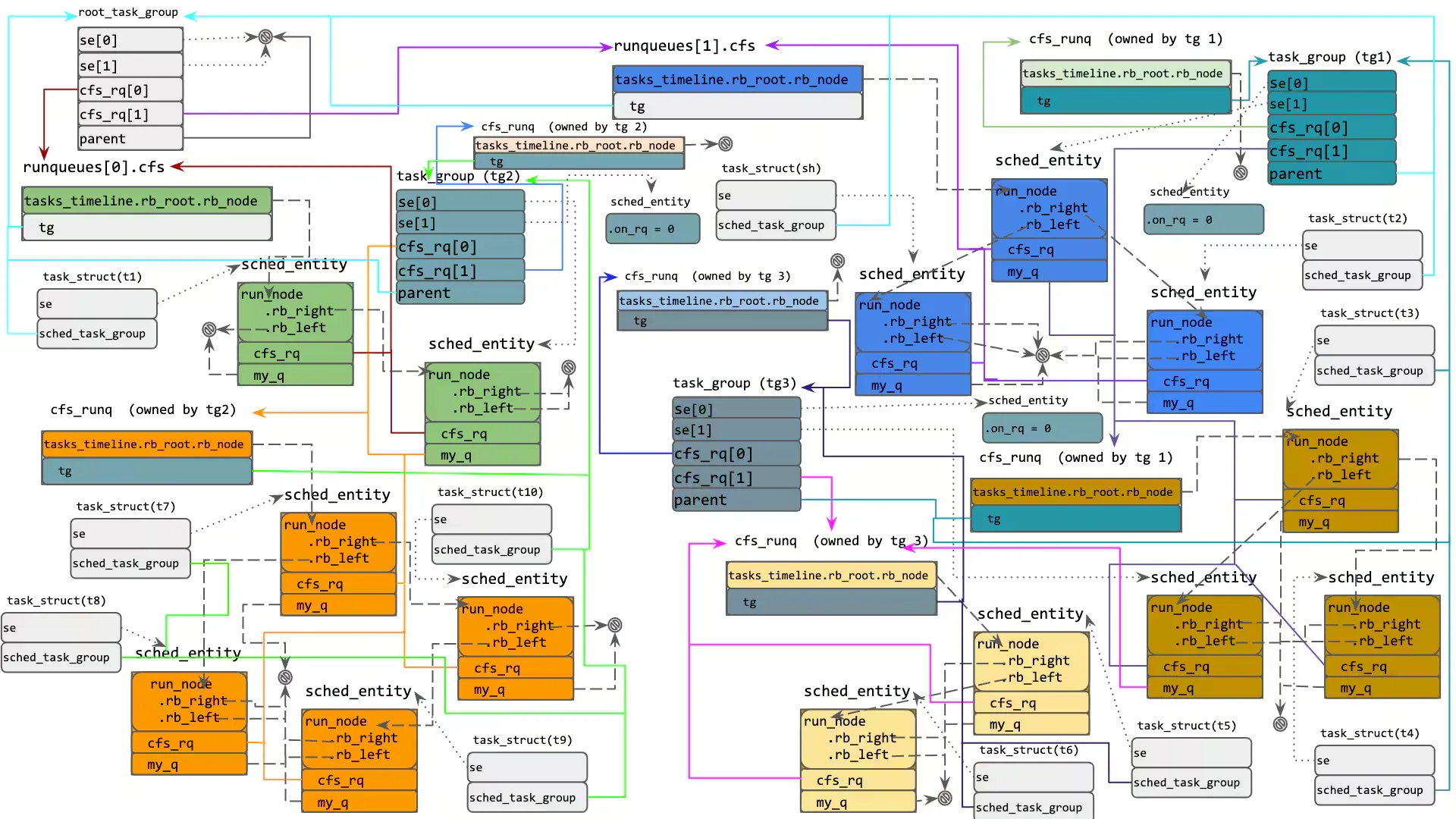
更详细一点的图片如下,摘自网络,意思一致